
Victorian Gothic Texts and Women’s Repressed Desires
In this presentation, Usha Gunatilake argues that Victorian women writers used the supernatural elements of Gothic fiction to explore women’s repressed desires in a socially acceptable way.

Techno-Utopianism in Nalo Hopkinson’s Midnight Robber
In this conference presentation, Nareka Brown explores how Nalo Hopkinson critiques techno-utopianism in the novel Midnight Robber.

Where Poetry and Science Meet
In this conference presentation and artist talk, poet Arden Howard explores the intersections of poetry and science.
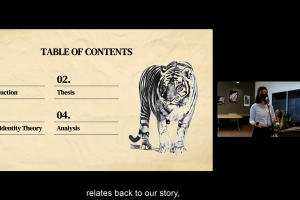
Analyzing Dress in The White Tiger
In this conference presentation, Lynn Shibata analyzes the significance of dress in Aravind Adiga’s novel The White Tiger.
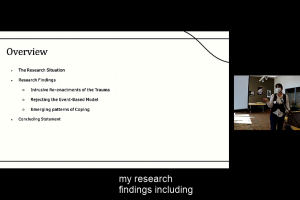
Indigenous Literature as Trauma Narrative
In this conference presentation, Roua Aldash argues that a decolonized trauma theory offers an effective lens for interpreting various works of Indigenous literature.
Posthumanism and Brown Girl in the Ring
In this conference presentation, Lillian Philipp-Tajcnar uses theories of posthumanism to interpret Nalo Hopkinson’s dystopian novel Brown Girl in the Ring and its treatment of spirituality.
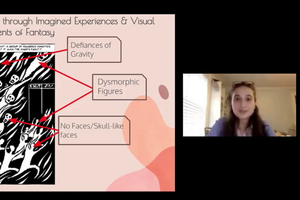
Collective Witnessing in Persepolis
In this class presentation, Lillian explores how Marjane Satrapi uses visual elements to bear collective witness to trauma in the graphic memoir Persepolis.
Historical Orienters in Graphic Narratives
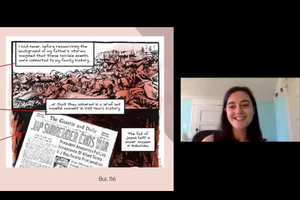
In this short class presentation, Tova Gaster argues that Thi Bui includes images of newspapers to help contextualize cultural trauma for an international audience in the graphic memoir The Best We Could Do.
Panel on Graphic Narratives
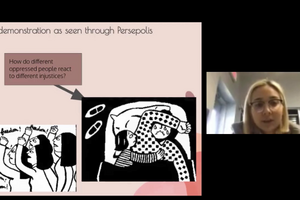
In this full panel of classroom presentations, the four speakers discuss different narrative techniques used in graphic memoirs and field questions on their presentations.
Capitalism, Disease, and Gender in Severance
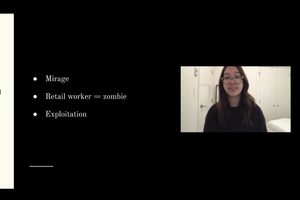
In this conference presentation, Sam Mumford argues that Ling Ma’s critique of capitalism in the novel Severance develops through its treatment of disease and gender.